
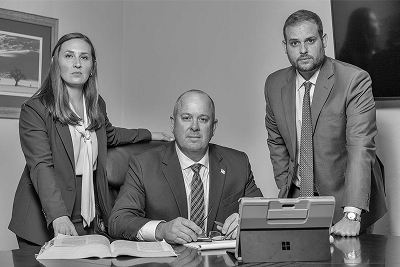
A burglary arrest can lead to a felony charge, even when no property was taken and no door was forced open. The degree of the charge depends on where the alleged burglary occurred, whether anyone was present, and whether a weapon, assault, or significant damage was involved. If you or a family member has been arrested in Cape Coral, the Law Firm of Scott T. Moorey can explain the charge and help you understand the next steps.
Our law firm represents people accused of burglary throughout Cape Coral and Lee County, as well as in Charlotte, Collier, Hendry, and Glades counties. Our belief that good people do get arrested guides how we treat each person accused of a crime. Learn about our Cape Coral criminal defense attorneys, theft and property destruction defense, and burglary defense. An allegation is not proof of guilt; the evidence and circumstances matter.
“Breaking and entering” is a familiar phrase, but Florida does not have a separate offense by that name. The charge is burglary under Florida Statute § 810.02.
A physical break is not required. In Jimenez v. State, the Florida Supreme Court explained that forced entry was not an element of burglary under the version of the statute then in effect. Today, the statute defines burglary as entering a dwelling, structure, or conveyance with intent to commit an offense, unless the place is open to the public or the person is licensed or invited to enter. An entry may involve only part of a person, such as an arm reaching through an opening, depending on the facts.
The statute also covers certain situations where someone initially entered with permission but then remained in a place surreptitiously with intent to commit an offense, after permission to remain was withdrawn with that intent, or to commit or attempt a forcible felony. Whether someone had permission and what they intended are often central issues. The state does not have to prove that a theft was completed.
Florida classifies burglary offenses by degree. Each is a felony, but the level and potential penalty depend on the circumstances. Enhanced sentencing may also apply in particular cases.
Burglary is a first-degree felony punishable by up to life imprisonment if, during the offense, a person commits an assault or battery, is or becomes armed with explosives or a dangerous weapon, or enters a dwelling or structure and uses a motor vehicle to assist in the offense and damages the dwelling or structure. First-degree burglary can also apply when damage to the dwelling, structure, or property inside exceeds $1,000.
When the first-degree factors do not apply, burglary of a dwelling is generally a second-degree felony whether or not someone is inside. The same degree can apply to an occupied structure or conveyance, an authorized emergency vehicle, or a structure or conveyance targeted for theft of a controlled substance. A second-degree felony can carry up to 15 years in prison.
Burglary of an unoccupied structure or conveyance that is not a dwelling is generally a third-degree felony when no assault or battery occurs and the person is not armed. The maximum prison term for a third-degree felony is five years. Cape Coral Police Department reports include vehicle burglary investigations, making car break-ins a relevant local example, but police releases do not establish which degree is charged most often.
Burglary allegations can arise in homes, vehicles, and businesses. Cape Coral police have reported residential incidents involving garages, along with overnight vehicle burglary investigations at apartment complexes. Cases may turn on witness accounts, occupancy, and evidence of intent.
Business cases may involve surveillance footage, employee or customer accounts, and digital records. For example, Cape Coral police reported a business burglary investigation in which employees provided detectives with surveillance video. An arrest or allegation does not establish what happened; the evidence still needs to be examined and tested.
Burglary and criminal trespass are different offenses. Burglary requires proof of intent to commit an offense inside, along with the statute’s requirements for entry or remaining. Criminal trespass under Florida Statute § 810.08 generally involves willfully entering or remaining in a structure or conveyance without authorization, or refusing to leave after being warned. It is usually a misdemeanor, though the statute has exceptions, including when a person is armed.
If the evidence does not establish burglary intent, that may weaken the burglary allegation. Whether trespass or another charge could apply depends on the facts and the evidence. A lawyer can review what the state relies on to infer intent, including the timing, statements, conduct, and any property allegedly taken.
There is no single defense that applies to every burglary case. A defense attorney will look at the accusation, the evidence, and how law enforcement obtained it. Possible issues include:
Our Cape Coral criminal defense lawyers assess the evidence carefully and explain which arguments may fit the case. A defense strategy depends on the specific facts; no attorney can promise a particular outcome. At our law firm, attorneys also review how burglary charges interact with related allegations, including robbery charges.
Cape Coral arrests are handled by the Cape Coral Police Department. Criminal cases proceed through Lee County and the 20th Judicial Circuit. Many criminal matters involving Cape Coral residents are handled at the Lee County Justice Center in Fort Myers; the location for a particular proceeding may depend on the case and its assignment. From our local law office, our lawyers can help explain the process and what to expect.
Florida classifies burglary as a felony, though the degree depends on the circumstances. The possible penalties also depend on the charge and any applicable sentencing factors.
No. The state may allege burglary based on intent to commit an offense inside even if the intended offense was not completed.
Burglary focuses on entering or remaining in a place with intent to commit an offense. Robbery involves taking property from a person by force, threat, or intimidation. The charges can arise from the same incident.
Yes. Florida’s burglary statute treats a motor vehicle as a conveyance. An alleged burglary of an unoccupied vehicle may be charged as a third-degree felony when the statutory conditions are met.
Avoid discussing the facts with investigators before speaking with a criminal defense lawyer. Contact an attorney promptly to understand the accusation, upcoming court dates, and what evidence may need to be preserved.
If you are facing a burglary or breaking and entering charge in Cape Coral or elsewhere in Southwest Florida, contact the Law Firm of Scott T. Moorey to discuss your situation. Our law firm offers free consultations and is available around the clock. A criminal defense attorney can review the allegations, explain possible options, and help you make informed decisions about representation by a local law firm.